Showing posts with label Faces - Photography.. Show all posts
Showing posts with label Faces - Photography.. Show all posts
Tuesday, May 13, 2014

Saturday, January 4, 2014
Gregory Colbert


Gregory Colbert (born 1960 in Toronto) is a Canadian film-maker and photographer best known as the creator of Ashes and Snow, an exhibition of photographic artworks and films housed in the Nomadic Museum. Colbert sees himself as an apprentice to nature. His works are collaborations between humans and other species that express the poetic sensibilities and imaginations of human and animals. His images offer an inclusive non-hierarchical vision of the natural world, one that depicts an interdependence and symmetry between humanity and the rest of life.In describing his vision, Colbert has said, '"I would define what I do as storytelling…what’s interesting is to have an expression in an orchestra—and I’m just one musician in the orchestra. Unfortunately, as a species we’ve turned our back to the orchestra. I’m all about opening up the orchestra, not just to other humans, but to other species.'"
via:wikipedia.org
Wednesday, November 6, 2013
Saturday, July 20, 2013
Saturday, November 24, 2012
Thursday, April 19, 2012

Friday, February 17, 2012
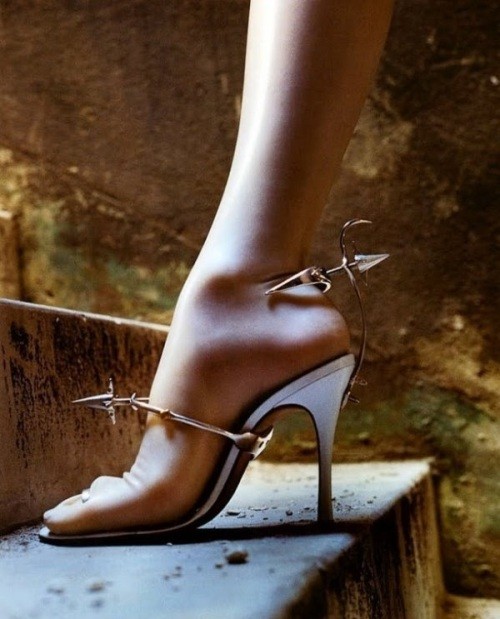
Lillian Bassman.

Lillian Bassman was born in June 15, 1917 and passed away at her Manhattan home on February 13, 2012.
Her parents were Jewish intellectuals who emigrated from Russia to the United States in 1905 and settled in Brooklyn, New York. She studied at the Textile High School in Manhattan with Alexey Brodovitch and graduated in 1933. While there, she met the photographer Paul Himmel and they were married in 1935. Himmel died in 2009 after 73 years of marriage. From the 1940s until the 1960s, Bassman worked as a fashion photographer for Junior Bazaar and later at Harper's Bazaar where she promoted the careers of photographers such as Richard Avedon, Robert Frank, Louis Faurer and Arnold Newman. Under the guidance of the Russian emigrant Alexey Brodovitch, she began to photograph her model subjects primarily in black and white. Her work was published for the most part in Harper’s Bazaar from 1950 to 1965. By the 1970s, Bassman’s interest in pure form in her fashion photography was out of vogue. She turned to her own photo projects and abandoned fashion photography. In doing so, she tossed out 40 years of negatives and prints - her life’s work. Over 20 years later, a forgotten bag filled with hundreds of images was discovered. Bassman’s fashion photographic work began to be re-appreciated in the 1990s. Into her 90s, she worked with digital technology and abstract color photography to create a new series of work. She used Photoshop for her image manipulation. The most notable qualities about her photographic work are the high contrasts between light and dark, the graininess of the finished photos and the geometric placement and camera angles of the subjects. Bassman is now one of the last great woman photographers in the world of fashion.
Bassman died on February 13, 2012, aged 94.
via: wikipedia.org
via: wikipedia.org


Wednesday, January 11, 2012
Anton Corbijn
Anton Corbijn
(Dutch pronunciation: [kɔrˈbɛin]; born 20 May 1955) is a Dutch photographer, music video and film director. He is the creative director behind the visual output of Depeche Mode and U2,having handled the principal promotion and sleeve photography for both for more than a decade. Some of his works include music videos for Depeche Mode's "Enjoy the Silence" (1990) and Nirvana's "Heart-Shaped Box" (1993), as well as the Ian Curtis biopic Control (2007)[4], George Clooney's The American (2010), and A Most Wanted Man (2012) based on John le Carré's 2008 novel of the same name.
via:wikipedia.org.
Thursday, January 5, 2012
Ed van der Elsken


Eduard "Ed" van der Elsken (10 March 1925 – 28 December 1990) was a Dutch photographer and filmmaker.His imagery provides quotidian, intimate and autobiographic perspectives on the European zeitgeist spanning the period of the Second World War into the nineteen-seventies in the realms of love, sex, art, music (particularly jazz), and alternative culture.


Thursday, December 29, 2011
In a state of expectation.
“Rue Brantôme”, Paris, 1947 - Izis Bidermanas
/3..jpg">
“Night scene at Elephant and Castle”, London, 1949 - photographer Bert Hardy

Rue Guérin-Boisseau, 2nd arrondissement” - photographer Robert Doisneau

/3..jpg">
“Night scene at Elephant and Castle”, London, 1949 - photographer Bert Hardy

Rue Guérin-Boisseau, 2nd arrondissement” - photographer Robert Doisneau

Friday, December 16, 2011


Monday, December 12, 2011
Monday, December 5, 2011
Alfred Cheney Johnston.
Alfred Cheney Johnston (known as "Cheney" to his friends and associates) (April 8, 1885 - April 17, 1971) was a New York City-based photographer known for his portraits of Ziegfeld Follies showgirls as well as of 1920s/1930s actors and actresses.
Johnston was born into a well-to-do New York banking family, which subsequently moved to Mount Vernon, NY. Initially he studied painting and illustration at the National Academy of Design in New York, but after graduating in 1908 (and marrying fellow student Doris Gernon the next year), his subsequent efforts to earn a living as a portrait painter did not meet with success. Instead, reportedly at the suggestion of longtime family friend and famed illustrator Charles Dana Gibson, he started to employ the camera previously used to record his painting subjects as his basic creative medium.
In approximately 1917, Johnston was hired by famed New York City live-theater showman and producer Florenz Ziegfeld as a contracted photographer, and was affiliated with the Ziegfeld Follies for the next fifteen years or so (he also maintained his own highly successful personal commercial photo studio at various locations around New York City as well, photographing everything from aspiring actresses and society matrons to a wide range of upscale retail commercial products—mostly men's and women's fashions—for magazine ads). He photographed several hundred actresses and showgirls (mainly in New York City, and whether they were part of the Follies or not) during that time period.
The only book known to have been published by Alfred Cheney Johnston during his lifetime devoted to his nudes/glamour photography is the 1937 spiral-bound softcover "Enchanting Beauty", which contains 94 black-and-white photos. Unusually (compared to virtually all other examples of his work seen today on the Web or other sources, which were shot in an indoor studio in front of a flat-black or illustrated tapestry background cloth), 37 of these photos were taken outdoors along a stream or in flower-dappled fields, etc. Unfortunately—but not surprisingly—all the shots in the book are "airbrushed" in the pubic area, to keep them legal with respect to the publishing standards of the day.
via:wikipedia.org
Johnston was born into a well-to-do New York banking family, which subsequently moved to Mount Vernon, NY. Initially he studied painting and illustration at the National Academy of Design in New York, but after graduating in 1908 (and marrying fellow student Doris Gernon the next year), his subsequent efforts to earn a living as a portrait painter did not meet with success. Instead, reportedly at the suggestion of longtime family friend and famed illustrator Charles Dana Gibson, he started to employ the camera previously used to record his painting subjects as his basic creative medium.
In approximately 1917, Johnston was hired by famed New York City live-theater showman and producer Florenz Ziegfeld as a contracted photographer, and was affiliated with the Ziegfeld Follies for the next fifteen years or so (he also maintained his own highly successful personal commercial photo studio at various locations around New York City as well, photographing everything from aspiring actresses and society matrons to a wide range of upscale retail commercial products—mostly men's and women's fashions—for magazine ads). He photographed several hundred actresses and showgirls (mainly in New York City, and whether they were part of the Follies or not) during that time period.
The only book known to have been published by Alfred Cheney Johnston during his lifetime devoted to his nudes/glamour photography is the 1937 spiral-bound softcover "Enchanting Beauty", which contains 94 black-and-white photos. Unusually (compared to virtually all other examples of his work seen today on the Web or other sources, which were shot in an indoor studio in front of a flat-black or illustrated tapestry background cloth), 37 of these photos were taken outdoors along a stream or in flower-dappled fields, etc. Unfortunately—but not surprisingly—all the shots in the book are "airbrushed" in the pubic area, to keep them legal with respect to the publishing standards of the day.
via:wikipedia.org


Sunday, November 20, 2011
Heinz Maier’s amazing photos of water drops
Heinz Maier recently started photographing last year. His main interest is in macro photography, specifically water drops (featured here) and insects. Maier is based in Leinzell, Germany.


via: Feature Shoot


via: Feature Shoot
Wednesday, November 2, 2011
André Kertész

André Kertész (2 July 1894 – 28 September 1985), born Kertész Andor, was a Hungarian-born photographer known for his groundbreaking contributions to photographic composition and the photo essay. In the early years of his career, his then-unorthodox camera angles and style prevented his work from gaining wider recognition. Kertész never felt that he had gained the worldwide recognition he deserved. Today he is considered one of the seminal figures of photojournalism.
Expected by his family to work as a stock broker, Kertész pursued photography independently as an autodidact, and his early work was published primarily in magazines, a major market in those years. This continued until much later in his life, when Kertész stopped accepting commissions. He served briefly in World War I and moved to Paris in 1925, then the artistic capital of the world, against the wishes of his family. In Paris he worked for France's first illustrated magazine called VU. Involved with many young immigrant artists and the Dada movement, he achieved critical and commercial success.
Due to German persecution of the Jews and the threat of World War II, Kertész decided to emigrate to the United States in 1936, where he had to rebuild his reputation through commissioned work. In the 1940s and 1950s, he stopped working for magazines and began to achieve greater international success. His career is generally divided into four periods, based on where he was working and his work was most prominently known. They are called the Hungarian period, the French period, the American period and, toward the end of his life, the International period.
via: wikipedia.org

The Forc.

Circus Budapst 1920

Satiric Dancer 1926.

Nude.

Saturday, October 8, 2011
Helmut Newton Photobook.
Helmut Newton, born Helmut Neustädter (October 31, 1920 – January 23, 2004) was a German-Australian photographer. He was a "prolific, widely imitated fashion photographer whose provocative, erotically charged black-and-white photos were a mainstay of Vogue and other publications."
He established a particular style marked by erotic, stylized scenes, often with sado-masochistic and fetishistic subtexts. A heart attack in 1970 slowed Newton's output, but his notoriety continued to increase, most notably with his 1980 "Big Nudes" series, which marked the pinnacle of his erotic-urban style, underpinned with excellent technical skills. Newton also worked in portraiture and more fantastical studies.
Newton was fond of his hometown of Berlin, and in October 2003 he donated an extensive photo collection to the Prussian Cultural Heritage Foundation, establishing the Helmut Newton Foundation. The foundation's mission is the conservation, protection and presentation of the oeuvre of Helmut Newton and Alice Springs.
This summer I had the chance to see this collection. I'm not a follower of the fashion photography, but I'm glad that I took a first- hand look at the creativity work of such a great photographer.
Friday, July 29, 2011


Subscribe to:
Posts (Atom)